
Technical Pioneers. A clock with no battery, no plug and no winding key, powered by the air in the room.
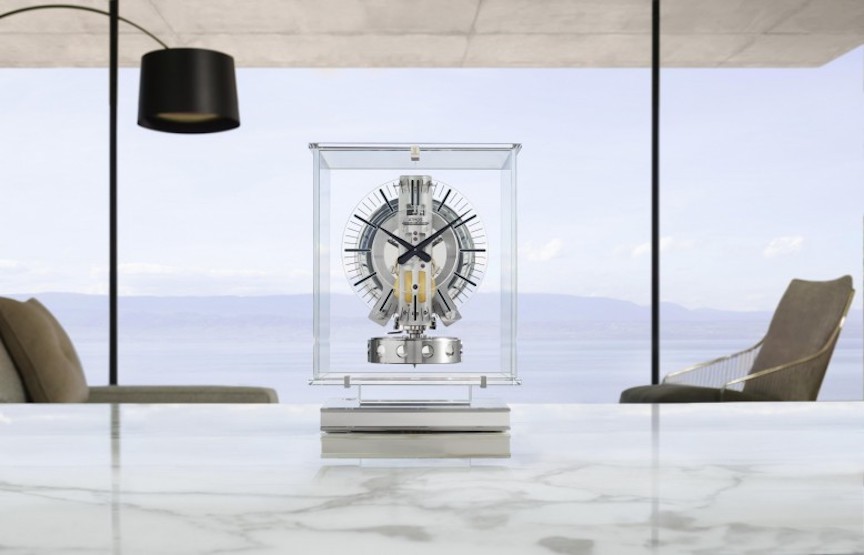
Most clocks need a key, a battery or a plug. The Jaeger-LeCoultre Atmos needs none of them. It winds itself from the small, everyday changes in the temperature of the room it sits in, and it has been doing so, in one form or another, since the late 1920s.
The problem
The dream of a clock that never needs winding is as old as clockmaking, and the laws of physics say a true perpetual motion machine cannot exist. The Swiss engineer Jean-Léon Reutter spent much of his life chasing the next best thing: a clock that takes its energy from something the room provides for free.
The invention
Reutter named his invention the Atmos because it ran on atmospheric changes. His first model had a glass capsule filled with mercury and ammonia, fitted inside a metal bellows. As the temperature and pressure of the room changed, the gas and liquid expanded and contracted, which moved the bellows and wound the mainspring. His employer, the French firm Compagnie Générale Radio, made the first working examples.
The efficiency is striking. A temperature change of a single degree Celsius, in either direction, is enough to keep the clock running for about two days. The balance swings just twice a minute, against 480 beats a minute in a typical wristwatch, and the gear trains need no oil. Jaeger-LeCoultre likes to point out that it would take 60 million Atmos clocks to use as much energy as a single 15-watt light bulb.
The early models
Reutter struggled both to make the clock reliable and to sell it. The story goes that Jacques-David LeCoultre spotted an early Atmos in a shop window and bought it, which led to LeCoultre acquiring the patent and applying its watchmaking talent to the problem. The Atmos 1, around 1930, was plagued by technical trouble. For the Atmos 2, released in 1936, LeCoultre replaced the mercury with a more stable gas, ethyl chloride, and made the clock respond to temperature alone. Full production only began in 1939. In between, in 1937, Jaeger and LeCoultre merged into the firm we know today, which is why the Atmos is a Jaeger-LeCoultre product.
How people reacted
Early buyers are poorly documented, but the clock’s reputation grew from the 1950s, when the Swiss government began giving the Atmos as an official gift to heads of state, a tradition that lasted into the 1980s. It became known as the President’s Clock. Recipients are said to include Winston Churchill, Charles de Gaulle, John F. Kennedy, Ronald Reagan, Charlie Chaplin and Pope John Paul II, and Jaeger-LeCoultre’s heritage director believes the Vatican holds the largest collection of Atmos clocks in the world.
How it evolved
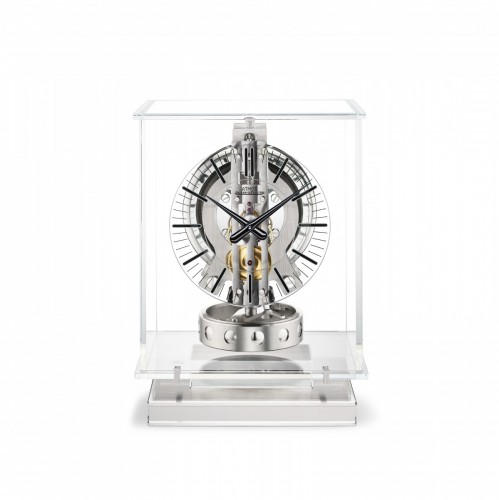
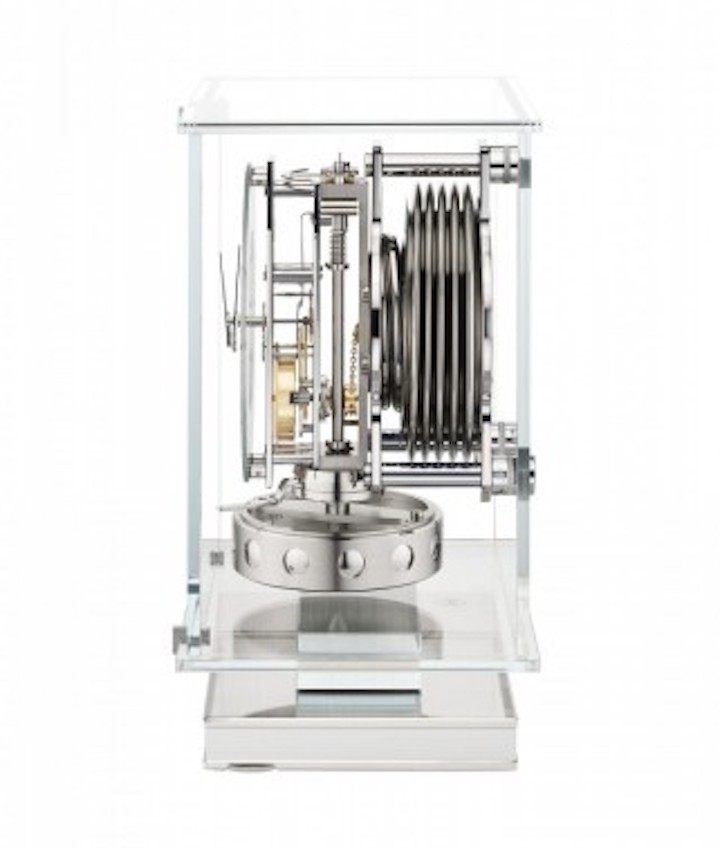
The principle has barely changed. The cases have. In 1973 the designer Luigi Colani gave the Atmos a squared dial in a steel cube. The Atmos Marqueterie du Millénaire of 2000 added a 1,000-year calendar and Art Nouveau marquetry, and a 2013 edition with Hermès used a glass globe made by Saint-Louis. In 2016 the designer Marc Newson, with crystal from Baccarat, made the Atmos 568, whose movement seems to float inside a nearly invisible cabinet. The 2019 Atmos Transparente, with its 217-part Caliber 563, shows the whole mechanism, including the bellows that act as the clock’s lungs.
The limit is energy. The clock runs on so little that adding complications is hard, which is why moon phases, regulator dials and an equation-of-time display have arrived slowly. The heritage director says a repeater or perpetual calendar might come next.
Why it matters: the Atmos is the cleanest demonstration of a watchmaker’s oldest instinct, which is to make time run on almost nothing. It is nearly perpetual, but not magic: it simply turns the room’s own breathing into energy. The patent has long expired, yet Jaeger-LeCoultre is said to be the only maker still using the idea.
Key facts
| Inventor | Jean-Léon Reutter, Swiss engineer |
| Prototype | About 1927 to 1928 (Atmos 0, not sold) |
| Atmos 1 | About 1930; mercury and ammonia capsule; plagued by technical problems |
| Atmos 2 | 1936; ethyl chloride capsule; full production from 1939 |
| Company | Jaeger and LeCoultre merged in 1937 |
| How it runs | Sealed gas-and-liquid capsule winds the mainspring as the temperature changes |
| Energy needed | One degree Celsius gives about two days of running |
| Balance speed | Two beats a minute; gear trains need no oil |
| Modern example | Atmos Transparente (2019), Caliber 563, 217 parts, launched at US$9,450 |
Sources: WatchTime, “Running On Air: The History of the Jaeger-LeCoultre Atmos Clock” (31 January 2022); ATimelyPerspective on the Atmos Transparente (17 December 2019); Haute Time on the Atmos workshops; Watchilove; Clockguy’s Atmos history. Sources differ on some early dates; we follow WatchTime. Images: Jaeger-LeCoultre press images as published by ATimelyPerspective; no Jaeger-LeCoultre media kit was available to us.

