
Technical Pioneers. Instruments for the high and the deep, with an India connection that runs back to 1865.
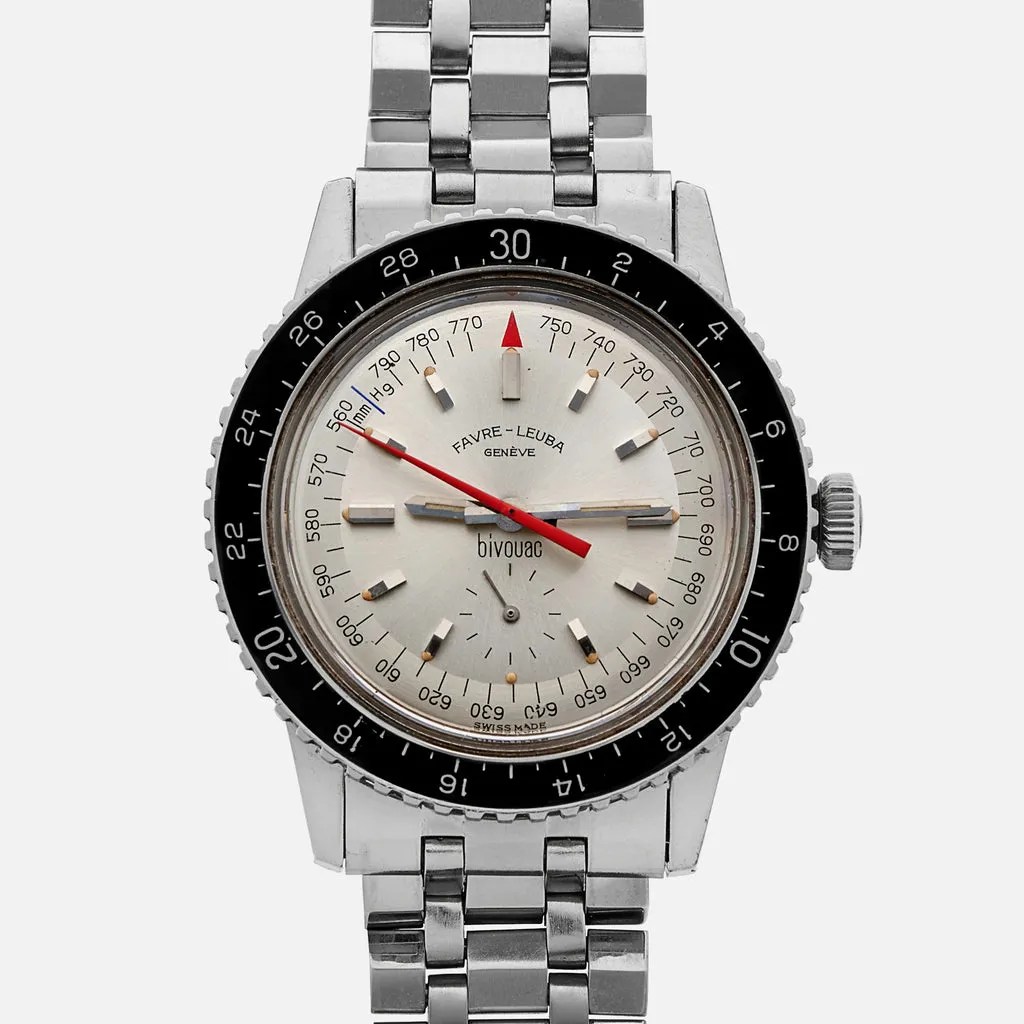
Favre-Leuba’s first official mention dates to 13 March 1737, when Abraham Favre was recorded as an independent watchmaker in Le Locle. Its reputation, though, rests on three tool watches made in the 1960s: the Bivouac, the Deep Blue and the Bathy.
The inventions
The key idea was to put a pressure sensor, an aneroid capsule, inside a mechanical wristwatch. In the Bivouac of 1962 it showed altitude and air pressure. The brand says it is the first mechanical wristwatch to do so. Underneath sat the FL251, a patented movement only 2.95 mm high that used two barrels to make an extra-flat calibre with a centre seconds hand practical to build in numbers.
Favre-Leuba then took the same principle underwater. The Bathy of 1968 used a membrane to show not only elapsed dive time but the current depth, which the brand calls a world first for a mechanical wristwatch.
The early models
The groundwork was laid earlier. The company made its first in-house calibre, the FL101, in 1955 for the Sea Chief, Sea King and Sea Raider, and introduced a dive watch it calls Water Deep in 1960. The Bivouac followed in 1962, the Deep Blue, rated to 200 metres, in 1964, and the Bathy in 1968. The line from one to the next was practical: each watch took what the previous one learned about sealing and sensing pressure.
How customers reacted
The audience was people who needed the answer. The Bivouac’s first mission, the brand says, was on the wrists of the Swiss national parachuting team at the 1962 World Cup in the United States. In 1964 the Italian climber Walter Bonatti wore one on the north face of the Pointe Whymper in the Grandes Jorasses, and the polar explorer Paul-Émile Victor relied on his on expeditions. Michel Darbellay took one up the Eiger solo in 1963. Wikipedia adds that Junko Tabei wore a Bivouac on her 1975 Everest ascent. The brand won first prize in the chronograph and sports watch category at Expo 67 for the Centurion.
How it evolved
The quartz crisis ended the family’s run, and the brand was sold in the 1980s and changed hands several times. Titan bought it in 2011, and after a relaunch it is owned today by the Indian retailer Ethos, according to Wikipedia. The modern Raider Bivouac 9000, introduced in 2017, measures altitude mechanically to 9,000 metres, and the brand says it reached the summit of Everest in 2018. The Raider Bathy 120 MemoDepth marked the Bathy’s 50th anniversary that year.
The India link: the brand says it became the first Swiss watch house to enter India in 1865, and after the Second World War its Bombay office made India its most important market.
Key facts
| Founded | 1737, Le Locle (Abraham Favre); name Favre-Leuba from 1815 |
| First in-house calibre | FL101, 1955 |
| Bivouac | 1962; mechanical altimeter and barometer; FL251, 2.95 mm high |
| Deep Blue | 1964; 200 m |
| Bathy | 1968; mechanical depth gauge |
| Revival pieces | Raider Bivouac 9000 (2017), Raider Bathy 120 MemoDepth (2018) |
| India | Entered 1865; Bombay office from 1945 |
Sources: Favre-Leuba history page (favreleuba.com); Wikipedia’s Favre-Leuba entry; Monochrome Watches; WatchGecko; EveryWatch listing for the Bivouac ref. 53213 and its history notes. The “firsts” are the brand’s own claims. Image: a dealer photograph of a c. 1960s Bivouac ref. 53213 via EveryWatch; no brand media kit was available to us.

